
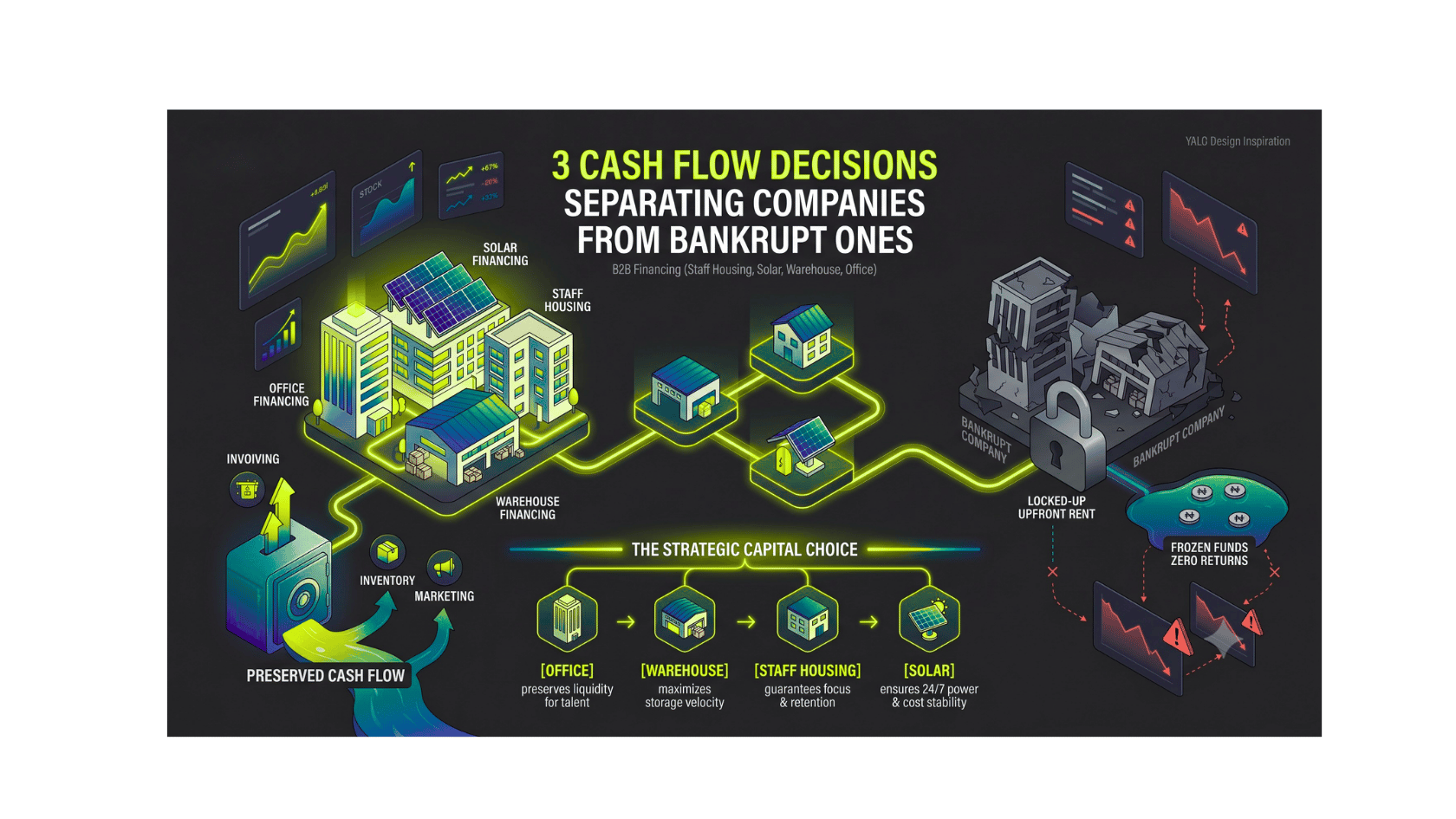
Most business owners think companies go bankrupt because they run out of revenue.
They are wrong.
Companies go bankrupt because they run out of cash. Revenue is vanity. Cash flow is sanity. If you have ₦100 million in booked revenue but zero naira in the bank when payroll hits, you are out of business. It is that simple.
When a company experiences rapid growth, the founder usually celebrates. They look at the sales charts going up and to the right and assume they are winning. But rapid growth is the most dangerous phase in a business’s lifecycle. As demand increases, you suddenly need more inventory, larger facilities, more staff, and stronger operational infrastructure.
This is where the trap snaps shut.
Without strategic planning, the sheer velocity of your growth creates an aggressive, invisible squeeze on your liquidity. The business starts eating cash faster than it collects it. You find yourself in a position where a single unexpected challenge or operational bottleneck can break your entire company.
Over the years, after watching thousands of businesses scale—and analyzing the smoking craters of the ones that went bust—I realized that failure rarely comes down to working harder. It comes down to capital allocation.
There are three distinct cash flow decisions that separate the companies that scale into multi-billion naira enterprises from the ones that quietly file for liquidation.
Here they are.
Decision 1: Treating Capital Allocation as an Expense Problem Instead of an Opportunity Cost Problem
When an annual commercial lease or facility invoice drops on a founder’s desk, the standard reflex is to look at the bank account and ask: “Can we afford this?”
If the bank account has ₦8 million, and the upfront rent is ₦8 million, the unoptimized founder pays it. They pat themselves on the back because they “covered their overhead.”
This is a structural error.
Every single naira inside your business must have a specific job. When you commit capital to an asset, you should have a clear expectation of return. When you invest in high-converting ad spend, you expect a return. When you invest in raw materials, you expect a return.
But when you hand a massive chunk of working capital over to a landlord for 12 months of upfront infrastructure, what is the immediate return on that investment? Zero.
That money sits completely frozen inside a building before it generates a single naira in value. It cannot buy inventory , it cannot support a new product launch , and it cannot finance aggressive customer acquisition campaigns.
The smartest founders do not just look at what an asset costs today; they calculate the opportunity cost of the money they are freezing. If that same ₦8 million could be used to restock high-velocity inventory, settle supplier invoices at a bulk discount, or acquire thousands of new paying users, paying it all upfront to a landlord is a massive operational blunder.
Scaling companies keep their capital productive. They decouple infrastructure access from capital drainage, ensuring their cash stays fluid enough to capture market opportunities immediately.
Decision 2: Allowing Storage Limitations to Cap Sales Velocity
Imagine securing a massive distribution contract or seeing a 200% spike in customer demand, only to realize your physical footprint cannot support the volume.
This is where business-related stress allocation shifts from a minor headache into a full-scale crisis. Many founders assume that losing customers is a marketing problem. It isn’t. Frequently, it’s an infrastructure bottleneck. They turn away valuable sales or experience severe stockouts because they simply lack the physical capacity to carry sufficient inventory.
When your stock levels are constrained by inadequate facility size, your entire supply chain breaks down:
~ You are forced to purchase smaller inventory quantities from manufacturers, completely missing out on bulk-purchase discounts.
~ Your staff spend double the hours trying to locate, track, and process disorganized items in an overcrowded space.
~ Delivery timelines stretch, customer trust weakens, and your buyers naturally migrate to competitors who can supply them faster.
The cost of staying small is always significantly higher than the cost of strategic expansion.
However, bankrupt-bound companies try to solve this by taking short-term, high-interest borrowing or completely draining their remaining cash reserves to acquire larger warehouses upfront. Scaling companies utilize structured warehouse financing. They aggressively expand their physical storage capacity proactively—preparing for future demand before the pressure arrives—while keeping their cash free to maintain inventory velocity and profitability.
Decision 3: Permanently Inflating Fixed Payroll to Solve Relocation and Welfare Realities
When top-tier talent starts missing milestones, showing declining morale, or quietly handing in resignation letters, the standard corporate solution is to throw more salary at the problem.
This is a short-sighted fix that quietly cripples a scaling company’s balance sheet.
Behind high employee turnover and low workplace productivity lies a silent drain that rarely shows up in performance reviews: macro personal financial stress. When your best performers spend hours fighting brutal daily commutes, worrying about heavy personal lease deadlines, or struggling with relocation logistics, their cognitive focus shifts from high-performance execution to basic survival. Throwing a 20% salary increase at them might offer temporary relief, but it permanently inflates your company’s fixed monthly payroll obligations regardless of market cycles.
High-growth companies treat employee welfare as a strategic retention advantage, not an isolated human resources expense.
Instead of locking themselves into unsustainable payroll increases, they deploy flexible, B2B staff housing financing structures. By covering the upfront bulk accommodation costs for their core workforce and structuring it into predictable, non-payroll strain models, they achieve three critical metrics simultaneously:
1. They secure absolute team focus, punctuality, and operational alignment close to the workspace.
2. They create an uncopyable employer brand that attracts premium industry talent without balance-sheet shocks.
3. They preserve critical organizational capital to fuel direct revenue generation.
Talented people build scaling organizations. Keeping those people stable, focused, and loyal is far less expensive than constantly absorbing the heavy liabilities of replacing them.
The Strategic Blueprint: How to Execute with Agility
If your organization is currently facing an infrastructure bottleneck, a major lease renewal cycle, or capital constraints that are delaying your expansion plans, the time to restructure your capital allocation is now.
Do not make vital business choices based strictly on what cash is sitting in your account today ; plan for what that capital must actively achieve for your runway tomorrow.
The transition from an unoptimized financial structure to a highly resilient model requires three deliberate steps:
THE LIQUIDITY ENGINE
1. Audit Fixed Overhead Allocation
Identify every naira currently sitting idle in long-term commercial rent or infrastructure deposits. |
2. Leverage Dedicated Corporate Financing Layers
Shift bulk warehouse, office, and solar equipment payments to structured, predictable tenors.
3. Redirect Unlocked Working Capital
Aggressively deploy freed liquidity directly into inventory velocity, active marketing, and sales.
To integrate your business into a scalable, zero-friction corporate financing ecosystem, visit here to get started today. Register your organization through our dedicated Partner Portal, access tailored infrastructure rent financing, and structure your overhead around your long-term ambitions—never against them.
If you are looking for flexible rent solution, you should read this beautiful piece and learn more before making a decision.
Ready to get started with your rental applications, shhhh. . . Don’t let others know, get started here